Kingfisher Inn's Fishing Report
for the Lower Laguna Madre
From now on, we will be using Capt. Scott's Blog to report
on fishing and other information of interest. This will allow you
to post comments and questions.
(Archived fishing reports going back to 6/25/01 also available here.)
8/30/11 OMG, what a great three days I had with Doug and Steve Gauntt this past weekend. The redfish parade was on every day--reds streaming toward us from the north, many oversized. I will post photos and the storyline later. A new video will follow, as well, titled, The Redfish Parade on the Lower Laguna Madre. Time is all I need to do these things, but between guiding, teaching, doing psychotherapy, and tending new relationships (oh yes), there's not much of it. But please know that the fly fishing on the LLM has been "storybook" of late.
8/22/11 At this moment, I am aboard a Southwest flight headed for home. I have spent the last week fly fishing in Colorado, which was an enjoyable change of pace, but not a substitute for stalking reds and trouts in the shallow clear waters of the Lower Laguna.
I have written less in the past few months about the fly fishing on the LLM. I have been to Holland, Virginia, the Northeast, and most recently to Colorado. In between, I have guided as much as I could fit in. So, what are the headlines at this stage in the season? Westside Shines in Places, Sand Action Disappoints So Far, and Big Trout Flourish. Rather than getting into a narrative to catch you up, I think I will simply share some photos that do a much better job of telling the story,

Beginning in late June, I started taking Rosie with me on guided trips. That might sound irresponsible, but it all started when my client--Tony Woodward of Colorado Springs, who happens to be a veterenarian--encouraging me to bring her, rather than leave her in the care or Rex and Shary White, who were more than willing to watch her. So I took her with us. It proved to be a high catching day, and Rosie fit right into the program. Indeed, the guys said that her presence enhanced their enjoyment. So began a new phase in my guide career.

The weekend with Tony Woodward and his fellow academic veteranarian Cody proved to be a memorable weekend, with Tony landing his largest redfish to date. Cody did well, too, especially for his first visit to the LLM.

After returning from Holland, I had the pleasure of guiding the son-and law of my first dance partner (in first grade), Cynthia Izaguirre (Champion). Her son-and-law had never fly fished in saltwater, but we had a great day that started off slow. Indeed, by midday we hadn't found any sight casting, but when we pulled into a lagoon to the south of the Arroyo, we heard explosions that seemed too loud and violent to be gamefish. They turned out to be over-sized reds cruising in pairs along a shoreline. For almost two hours, we had one shot after another. Corey managed to hook two, but broke off when the huge fish reacted violently to the hookset. He was a bit

There were other noteworthy charters, but I have to include Doug and Connie Gauntt, two of my favorite old clients from north Texas, who came in early August.


6/30/11 It's been a long time since I've posted a fishing report. I have been moving, and the process has been interminable. Nonetheless, I have been guiding quite a bit, and have a lot to share with you. But not now.
Suffice to say that fishing was difficult in the spring due to unusually high winds. The effect of El Nina, which produced the F5 tornados in Alabama and Missouri, was to "suck" even more wind out of the Gulf toward the low pressure systems to the north of us. But in the last two weeks, the winds have subsided, and the fishing has been good to superb. Just this last weekend, I guided my old client Doug Gaunt and his buddy Dick, who accompanies him on one of his trips each year. Both of them are excellent anglers--Doug with his fly rod, and Dick with his open-face reel casting a gold weedless spoon. In the two days of fishing the guys landed and released 55 redfish and a few trout, including several reds over 28 inches, and one 26" trout. The tides have fallen, so we are fishing much skinnier water, which supports more visibility of tailing, waking and cruising (with sunlight) fish. I will be posting a few photos from this trip in a day or so.
7/15/11 Capt. Randy here! Summer is in full swing and fishing has been great as the weather is stable and the fish have been in a cooperative mood collectively. A good day on the water is always made better for me when I can enjoy it with my boys. So, Saturday was a great day! Truett (now 16) continues to improve his fly fishing skills. In a few years he may well be

Saturday morning we woke up plenty early, but found ourselves dragging a bit. I had picked Truett up at the airport the night before; he had spent the previous week in Lubbock at the state FFA convention. Because of a flight delay and luggage issues we arrived home at 1AM. So 5 AM came early. Summer fishing with my boys is a pretty relaxed endeavor. The fish are more predictable and I do not feel the pressure to catch fish before the sun gets high in the sky. Understand, we catch plenty of fish early, but in the mid to late summer, I expect consistent fishing opportunities at most any hour of the day. This day did not disappoint. Based on a tip from a good friend and fellow fly fishing guide we started the day at a westside venue very near the intercoastal. As the skiff came to a gentle halt I climbed up on the platform and Truett tied on a Kingfisher spoon. For about an hour we had opportunities to cast spoon flies at groups of large trout moving up the shoreline with real determination. After working out a few kinks Truett was able to place the fly in perfect position and catch a nice trout. We all thanked her and gently slid her back into the clear, shallow water.
Next we made our way even further west into a secondary lagoon in search of redfish. Again, we were not disappointed. The lagoon is very shallow this time of year and fish were scattering soon as our boat arrived at our intended location. We considered wading, but elected to pole and let Truett do the hunting/ fishing with his fly rod. The photo you see is the result of teamwork; taken by a proud papa. After spending a couple of hours in this venue we moved east to the sand. The fish had not yet congregated on the sand for the day and we were satisfied so we called the day a little early and motored on home.
The fishing is great! Hope you can make it down. Give me a call and we will get you on the calendar.
4/13/11 Guided a couple from Bend, Oregon, on Monday. I hadn't been out in a few days, but I knew that the birding would probably be "on." The trouble was that the wind had been so strong out of the south that I doubted we'd be able to fly fish. I looked at the forecast the night before,

We left about 7:00 and headed for the only possible action on a windy, overcast day -- "birding" over podding redfish. This time of year, the reds congregate and feed on the brown shrimp that is maturing in the seagrass meadows.
The wind was about 15 out of the west, and scheduled to shift to the north by late morning or early afternoon. I knew that the fish didn't care about the wind, and the birds actually liked it, because it permits them to hover over the tailing reds without expending much energy. We planed into the area where birding is common, and didn't see anything for a couple of miles. My heart was starting to sink when I spotted the first group of birds. After that, it got better and better. When we left five hours later, the wind was 30 out of the north, and there were birds as far as you could see, hovering over feeding redfish.
Andy had never caught a redfish on a fly, and wondered if the weather would preclude that possibility. But as we poled toward our first group of fluttering gulls, we could see two more pods just beyond the first group. The fish were gathering and beginning to feed in earnest, and our spotters--the laughing gulls--were on top of the action.
Andy caught a couple of reds, and suddenly the wind came to a virtual standstill. The gulls sat down on the water, and followed the reds around. Meanwhile, we could see sweeping pods that had been invisible in the rougher water.
Neither Andy, his wife Kim, or I counted how many fish he caught. It didn't seem to matter. But he hooked at least a dozen reds, and landed almost as many. He landed four nice trout, too, that were feeding around

I have rarely seen clients happier. Indeed, they both were beaming when I took them to the dock at 1:00. I think I will seem them again. They were delightful company, and appreciated every aspect of the day's action.
3/2/11 Capt. Scott here. Chip and I planned to go fishing this morning, but when I got up it was cloudy, chilly, and blowing from the north. I'd already got dressed and told the dogs the good news when I first looked outside and said, Oh darn it! So I called Chip and we decided to can it. But then, only 30 minutes later, the clouds started to break up and the wind slowly subsided. I called Chip back, and he was on the road within minutes.
We headed south, way south, hoping for big

Still we got several strikes and landed a few up to 26 inches long before knocking off. We discussed the redfish action after returning to the boat, and agreed that they were already keying on brown shrimp, and would soon be tailing under birds. The spring birding action is poised to begin.
It was a great day, and we were grateful that we hadn't wimped out and headed in before checking all the right places.
1/8/11 Capt. Randy here. 2011 is upon us! During this season the slower pace of life that accompanies the Christmas holidays is juxtaposed with the anticipation of a New Year. Perhaps that is what I like most about the turning of the calendar each winter. Happy New Year to you all! I just spoke to one faithful Kingfisher Inn client who complained of 23 degree weather at his home. When asked, I sheepishly revealed that the high temperature today would be 78. I was a little embarrassed, and but mostly proud, to give him a positive answer to the question you all ask as you visit this fishing report; “How’s the fishing been?” I told him (and will now tell you) of Monday’s fishing trip, two days after Christmas. I went to bed on Sunday night before our planned fishing trip knowing that the forecast was calling for cooler temperatures (a high of 67) and low, thick clouds all day. But, the winds were expected to lay low all day. When Truett (my son) and I woke up the next morning we were in no hurry to rush out on the water because of the low temperature. So, we enjoyed a pot of coffee and waited for the arrival of my brother-in-law (Kevin) and his son (Phillip). They would be our fishing partners for the day. With a low ceiling and cool temps looming outside, I cautioned them about being too hopeful, but I could not help myself. I had a feeling there was just enough distance in time between us and the last cool front and that the day was shaping up to be a classic winter fishing day on the Lower Laguna Madre. I went with my feeling. We nudged the boat into the cool water around 10 AM. We fired up the Etec and burned a little gas scouting some of my son’s favorite duck hunting spots before I determined that it was time to go “hunting” for redfish. I use that verb intentionally and if you have ever had the pleasure of sight fishing down here then you know it is appropriate. In the span of ten minutes I had already brought the boat off plane in about 11 inches of water because of the sheer number of redfish that we were pushing off the bow as we motored along. The winter tides that arrived just over a month ago have recently made 80% of the fall’s accessible water now off limits in the LLM. That day we were just a stone’s throw off the ICW, yet it felt as though we were in a world of our own.
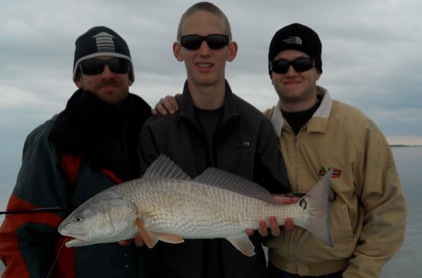
12/4/10 Capt. Scott here. I went out fishing with Randy Cawlfield and his son Truett today. We hadn't fished together in quite a while, although we are in regular contact over upcoming fly fishing clients and lodging logistics. The tides have fallen, and are approaching their winter lows, so instead of fishing north, I suggested that we head south where we tend to fish in January and February. It was early in the fall-winter to give up on Paytons, but I was hoping that we would find some giant trout in the super low conditions of S. Cullens Bay. We arrived at S. Cullens fairly quickly, thanks to the combination of a 70 hp Yamaha pushing a 475 lb skiff in Lamivent mode.

There were fish in S. Cullens, but the tailing sheepshead drowned out the more subtle signs of redfish, which weren't tailing at all. So instead of staying there, we headed east and south, thinking that we'd end up in north Paytons, 15 miles north. We cruised slowly along the edge of the sand, finding quite a few reds and big trout spread out over too large an area to justify stopping. But when we neared Green Island, we ran into quite a few redfish. So we shut down and poled for a while before we spotted tails popping up in the glassy conditions. We piled out of the Stilt, and spent a couple of hours sight casting to one tail after another before we headed back to the dock in time for Randy to preach in Brownsville. Imagine that! Putting preaching before angling! Perhaps that's why we did so well--we had our priorities straight. And while I'm not much of church goer, my meditation practice always takes precedence over anything else, too. Randy and I have a lot in common, and it's mostly something that you can't really talk about.
After I snagged a tailing red off the front of the Stilt while Randy poled me, I got off and followed Truett around with my Nikon d7000 in video mode. I got some fine footage (is that still what they call it?) of Truett stalking and hooking up on a couple of fine reds. Of course, my presence could have prevented him from catching more, but he never complained and did quite well regardless. I will be posting tha

11/26/10 It's a windy and chilly Black Friday, a good day for tying flies. It's nice to have some unpressured time with Kathy to visit and relax. Cold fronts pass quickly this early in the fall/winter, and the forecast calls for perfect fly fishing conditions on Sunday. We're taking the dogs out then, and may get some video to share with you. A thought for the day: If you never blame the fish or complain about the wind, you will eventually master your art. Remember Hewitt's words, "The fly is not the problem. It's what's on the other end of the line." This perspective puts everything within our reach if, that is, we are willing to accept responsibility.
11/24/10 Capt. Scott here. I have just posted a new video on YouTube, which covers the three consecutive days of flyfishing that I describe in my 1/10/10 fishing report below.
1/10/10 Capt. Scott here. It is unusual to have three clients in a row use the word "fantastic" to describe their fishing experience. But that's what

Saturday dawned cold and still. I didn't know it til later, but the temperature was 41 at daybreak. Maybe that's why I was chilled to the bone on the ride from our house to the Kingfisher dock, where I picked up Steve Novak and John Hunter from Beeville. I had donated a trip to the local CCA chapter, and John had purchased it. So it was a chance to "give back" to the organization that has made my life so much easier, and richer. Indeed, the Lower Laguna is a different place altogether than when I wade fished there as a kid. Catching a couple of game fish back then was a big deal. Today, it's commonplace to catch 10 or more apiece on a decent day. We owe a great deal to the Gulf Coast Conservation Assn, which became the CCA. If you're not a member, please consider joining. Working closely with the Texas Parks and Wildlife, the CCA has literally transformed the coastal ecosystem.
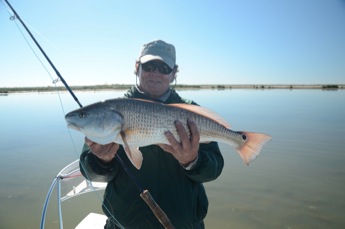
I took the guys way south, where we found a few reds cruising the shallows of South Cullens Bay. I poled them on the Stilt for a while, and let the rising sun thaw out our numb fingers. Soon it became clear that the reds weren't where we would sight cast to them. I knew they would probably come in later in the day, but we would have to wait patiently for hours, and then there was no guarantee that they would show up. So with some hesitation, I pulled the plug and headed north. On the way to where I believed the fish would be, I saw an area (which will go unnamed) that "called" to me. So I veered off my northward track and headed west to see why I felt the pull to go there.
Suddenly we ran into a wall of retreating reds, and so I shut down immediately. Tailing reds appeared almost immediately--in small pods of 4-6. For the next four hours, we poled the area in almost dead calm conditions. It was "storybook" fly fishing. Big, aggressive reds seized the fly without hesitation: the strong outgoing tide had really turned them on. Steve landed the first one -- a fat 27 inch red. Thereafter, Steve and John took turns, and had one shot after another until we headed in hours later. I don't know how many they caught, but they ran from 23-27 inches in length.
The next day I guided David Cole from Ft. Worth. I had met David at the FFF Coastal Conclave in Lake Charles a couple of years ago when Kathy and I were invited to speak. Since then, David had tried to come down and fish, but had been deterred by poor weather conditions on every occasion. Finally, we seemed to hit it right. We left the dock before sunrise, and headed for the same area where I'd fished the day before. The reds were there tailing in pods, but it was hard to get close enough to cast to them. Finally, David hooked his first red on a fly rod--a heft 27-inch red. He had achieved what he'd come to do--to catch at least one red. But as it turned out, it wasn't his last one.

I made a risky decision, and decided to leave the reds and go north onto the sand. I believed that the calm conditions would allow us to see tailing reds in the far eastern expanse of the LLM, where 8-9 inch water often attracted pairs and big single redfish that were cruising and tailing in the most sensitive and beautiful conditions. Here's a shot of David looking toward Padre Island in the distance.
Once the fish recovered from the boat's intrusion, singles, pairs, and triples began to tail in all directions, often 100 yards apart. Before long, David and I were poling up to one tailing group after another. Approaching them in the Stilt was effortless in the dead calm conditions, and they were especially tolerant of our approach. But David would only get one cast before the reds would slip beneath the surface, and begin to slowly depart from the area, leaving only a subtle wake on the mirror-like surface. It was frustrating at first, but David eventually got into a groove and landed three nice reds. We saw the last one approaching from at least 200 yards away.

The next day, I guided my old client Dr. Kirk Brown and his friend David from Dallas. We headed to the same spot where I'd fished the past two mornings. The reds were happily tailing in small groups, and we went from one group to another in the Stilt.


"Fantastic!" said Steve and John. "Fantastic," Said David Cole. "Fantastic," said Kirk and David. It's a weekend that I will remember for the rest of my life.
10/29/10 Capt. Scott here. I just guided Richard Back and his buddy Bob for the second time in less than a year, and finally got the video done from their last trip! Anyway, here's some classic tailing and "backing" action for redfish in one of our favorite places on the Lower Laguna.
10/16/10 Greetings from Kingfisher Inn! Capt. Randy here. And happy Fall to you all. For those who think that we don’t have a real Fall down here in deep south Texas, you should get down here and fish in the next 7 or 8 weeks. We may not experience the changing colors and freezing nights that some of you are enjoying. But, the mother lagoon is positioning herself for a splendid season that I know of us fall fishing. This is my favorite season

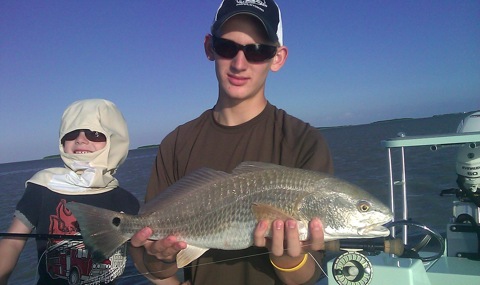
Come on down. We’d love to have you.
9/15/10 My client cancelled a trip last weekend with my wholehearted blessings due to weather. But Capt. Randy went out with his client Ed Calhoun, from San Antonio. Ed was already here, so the guys said, What the heck, let's do it! For myself, I enjoyed the rain, too -- from the comfort of my back porch overlooking the Arroyo. Randy's the preacher, but I have been known to preach a bit myself. So here's my sermon to you. Anyone can catch fish on a good day, and there's not much to learn when conditions are perfect. That's why guides tend to be such better anglers. They have to go out on days when they'd rather stay home, and consequently they see things and learn things that would astound you. And they sometimes catch fish, too!
Here's Randy's pithy report, and Ed's message to Capt. Randy upon returning home:

Capt. Randy "Not a great photo but a good depiction of the day. The fish was more stout than this photo depicts. Ed Calhoun from San Antonio caught his first red on a fly. This was his first opportunity to saltwater fly fish. Said this fish made the trip worth it. He is a courageous angler-you know what I mean. Says he will be back soon. Here is what he said:"
Randy,
Even though it was just 1 fish and I struggled with my casting at times, the technique used to stalking and
targeting fish will have me getting salty again soon. Thanks for such a low-pressure, enjoyable learning experience. Hope to do
it again soon,
Ed
8/30/10 Capt. Scott here.
Here's a couple of videos of recent fishing trips. The first one is of Gene Hansen and Ed Kilduff (see 8/15/10 report below), and the second trip was with Whit Jones from Hebbronville. I think you will enjoy the action in these videos. Classic west side action in virtually no water.
8/15/10 Capt. Scott here. The past week has been characterized by pretty fine early action on the west side, and a totally blown-out east side due to the flood runoff from the Mexico rains. The Arroyo is part of the south floodway, which was opened a month ago to help prevent flooding of the Rio Grande. The massive outflows have discolored our normally crystal clear water, and we have had to limit our sight casting to clear westside lagoons, and narrow strips adjacent to Padre Island. This influx of fresh water doesn't bother the fish, but it does make our sight casting more difficult.
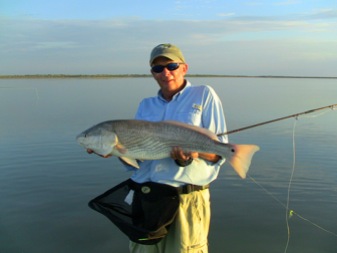
While the fly fishing overall has "sucked," as Doug Gauntt commented on his last of three days of fishing last week, there have been some stellar moments. It doesn't seem very bad, for instance, when you're casting your fly into a school of 200 reds, which are tailing and feeding in a calm, remote lagoon. Indeed, pulling a 31-inch red out of the pack seems like a dream come true, as it did for Gene Hansen two days ago just as the sun rose. I was guiding Gene and Ed Kilduff, both part of a group from the Maryland CCA, which came down for the past couple of years. The rest of the group accompanied Rick Hartman and Roel Villanueva for a journey to the "north country," where they did quite well.

We are expecting the LLM to clear up around Labor Day, as the fall tides surge a foot or so, bringing fresh ocean water into the lagoon. Meanwhile, the runoff flow is decreasing daily, so the intersection of these two factors will probably change the bay's appearance almost overnight.
8/1/10 Capt. Scott here. We have had a roller coaster ride this past month. June and early July were phenomenal fishing months. But then Hurricane Alex came, passing us to the south. We thought we'd been spared. But 50 inches of rain fell in the Mexican mountains to the south of us, resulting in a delayed effect, which culminated in severe flooding of the Mexican rivers, and an unprecedented influx of water into the Rio Grande and reservoirs upstream of us. Falcon resevoir was soon exceeding its capacity, so the authorities released up to 60,000 cubic feet per second to stave off the rapidly approaching flood conditions. Various downstream diversions resulted in the Valley floodway system being opened for the first time 30 years. We were enjoying good fishing throughout this buildup, but about two weeks ago, the waters reached Arroyo City. The water level jumped almost 18 inches overnight. Fishing became more difficult, and the clear water diminished by the day, reaching almost a complete "brown-out" a few days ago. Now the water is subsiding, and the water clarity is improving by the minute. Capt. Randy guided his son Truett during the Texas International Fishing Tournament Friday and Saturday and reported that they had no trouble finding reds and clear water. So many of our clients, who were awaiting word on the conditions, have opted to come on down. Indeed, we have a very full early August schedule. Once the waters drop another foot, we should enjoy story book fishing, because usually the fishing turns on phenomenally after a fresh water flush of the LLM. It may take a while for the water level to become normal, but until then we will be fishing productive back lagoons that are normally accessible only during the seasonally high tides of spring and fall.
Greetings from South Texas and Kingfisher Inn. Happy Fourth of July! Capt. Randy here. Well, we made it through Hurricane Alex just fine and I’m out fishing this morning as you are reading this report (I wrote it last night!). The hurricane made landfall over 100 miles south of us. We received much needed rain and some 40 mph winds, but are experiencing no lasting effects and only missed one day off fishing in the process!
Fishing has been excellent during the month of June. Summer mornings are generally marked by calm winds and sun. But, this summer has been even more beautiful than usual. Couple the beautiful weather with the aggressive pods of redfish that have been moving through one of my favorite west side venues, gorging themselves on migratory shrimp, and you have a recipe for good fish catching days.
I was out last week with two fine gentlemen from Dallas who made their first trip to Kingfisher Inn and the Lower Laguna Madre. They assured me it won’t be their last. Barry Johnson and Wayne Little woke up on their first morning to calm, favorable conditions. As we motored down the ICW I was hopeful and calm; emotions become more frequent as Spring gives way to Summer fishing patterns. Don’t get me wrong.

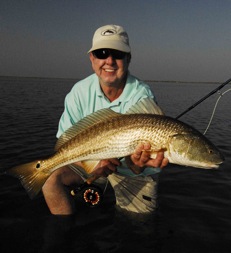
So, we were motoring down the ICW and I was hopeful and calm...As the sun was making its first appearance of the day we skimmed over the shallow water of the previously mentioned favorite west side spot. I shut down the Evinrude a little earlier than the anglers expected (evidence of the confidence I was feeling) and we began our first “hunt” of the morning. Some mornings take a bit more time to unfold than others. And this was one of those mornings. I could have easily pulled the plug on our first attempt and moved on. But, the morning and the spot just felt right. And there were laughing gulls in the distance displaying the same hopeful confidence that I was feeling. So, we continued to pole along-waiting and watching. And, our patience was rewarded. As the light of day became a little more favorable for sight fishers, we began spotting, then stalking pods of aggressively feeding redfish; tails wagging out of the water and snouts buried in the grass. These pods were made of big fish chasing big shrimp. I know that because several fleeing shrimp jumped right into the boat. The rest of the story is hard to describe unless the reader has been down here and experienced a great day of fly fishing the LLM. Barry, Wayne and I had two great days of fishing, laughing, and enjoying sights that few anglers are blessed to have experienced. This photo records Wayne’s first redfish on the fly. Good times Barry and Wayne. I will look forward to your return!
6/6/10 Capt. Scott here. It's been a long time since I've posted a written report. It's hard to improve on video, and it takes so long to edit a video that by the time I'm finished, I don't particularly want to start over and write a narrative that falls short of the video. However, I know you want to know what's happening, and words do matter. So, to make this brief before I post yet another video later today, suffice to say that the sand has been consistently good, if not great. Our west side action has improved, especially since the spring winds have subsided. Indeed, we have had some phenomenal tailing action in certain west-side locales, including whole schools of reds feeding aggressively––backs and tails showing––on certain mornings. I am posting a new sand action action now, abut will be posting a video of some mouth-watering tailing action in a picturesque west-side venue later today or tomorrow.
Birding action continues, but I have skipped it entirely on some mornings because the tailing action in other areas is a higher quality opportunity.
For those of you who live far away, please realize that the BP leak has had no effect whatsoever on the south Texas Gulf coast. While we hope and pray that it will be capped soon, we really don't expect any effects, even if it should continue to leak until the relief wells are completed.
5/7/10 We have had some great fly fishing in the last week. Instead of telling you stories of what's happened, I shot two videos--one in which I am fly fishing alone, and a second in which I am guiding two gentlemen from Colorado Springs. I hope you enjoy them. (If you want to see all of my videos, take a look at our Videos page.)
4/17-4/18/10 As told by Randy's son Truett Cawlfield, age 14, prodigious fly fisher! (Capt. Scott's assessment, having had the opportunity to fish with Truett.)
My Dad and I fished Saturday and Sunday of this weekend. Yesterday was not too productive, only offering a few shots. The laughing gulls which generally indicate where pods are in this time of year looked as confused as we were. So, today as we headed down the Arroyo and saw the clouds. I expected to be searching for pods like on any typical spring day. But, as we headed down our usual path I was surprised when my Dad took a sharp turn and we started down a mangrove channel leading inland to a large saltwater lagoon. We drove through the channel and drove onto a huge sheet of glassy water.

4/17/10 Capt. Scott here. (The story of Truett Cawlfield's trophy trout will soon follow. Take a look at the home page to see his fish!)
Headlines: Brown tide totally gone, birding action turns on, and the sand is covered with reds. Yesterday was one of those days that ended far better than it started. I had no way of contacting Lou Purvis and his brother Jeremy to discuss possible cancellation due to weather, so I headed down to Kingfisher and picked them up, all the while viewing the weather radar on my Iphone. It didn't look good. Only a few boats were heading out, and we could see showers to the south and west. Still, we launched the Stilt, hoping for the best. But just as I gunned the Yamaha and drove the skiff onto plane, the rain hit. So we looped back and stood in the overhang of the men's bathroom at the County Park, waiting for clearer conditions. I pondered our options, and wondered if the wiser and safer choice would be to go home.
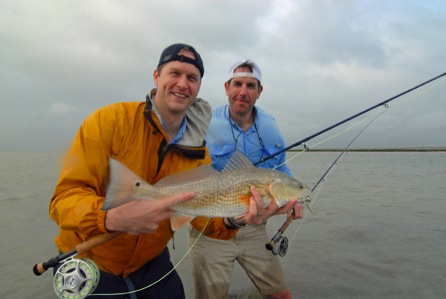
Well, we found birds! Jeremy had never caught a redfish on his fly rod, and Lou was as hopeful as he was that this would be the day. A group of 20 gulls were screaming and swooping down upon a group of tailing reds and three more groups could be seen nearby. So Jeremy went hiking toward the nearest group, and Lou joined him -- not to cast but to encourage and coach him through his first hookup. Not surprisingly, Jeremy casted a couple of dozen times to the pod before he got the first red to see the fly.What happens is that the reds are tightly grouped, and often facing away from the caster. If the fly lands anywhere between the angler and the tails, the first don't see it, because they're looking the other direction. To the newcomer, it seems as though the reds "aren't eating." But that's exactly what they are doing when they are tailing with birds overhead. They're eating, but they're not seeing. It's hard to believe that you can cast so many times to a large group of fish without having one see it, but a miss is as good as a mile when they are tightly packed and looking down.
Jeremy finally hooked a red and landed him after requisite hoops and hollers from Lou and me. Lou was as happy as his brother was. After photographing the red, both brothers set out in opposite directions toward nearby pods. It started raining, so I couldn't photograph their catches, but Jeremy caught two fat trout, and Lou landed a red. So we were off to a good start on an otherwise bad weather day.
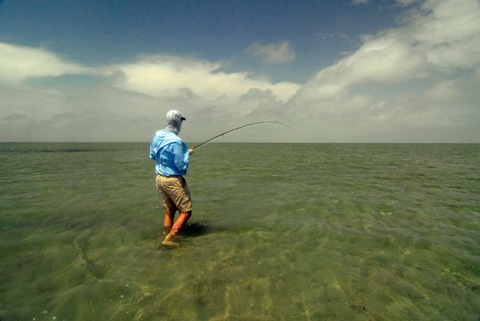
And it got better! After running around fruitlessly looking for more pods, we headed east onto the sand. I thought I was dreaming when the clouds parted. Indeed, when we got to the sand, the water was so clear and green and bright that even without the presence of fish, I would have been happy. Poling downwind, and taking stock of the situation, the guys soon spotted and casted to several redfish from the Stilt, so we decided to stake the boat and wade. For about three hours, the guys had almost constant action--singles and doubles, and reds mixed with ladyfish behind sting rays. The fish were really turned on, but they weren't pushovers, and would see the anglers from pretty far out. It didn't stop the guys from having some success, and enjoying every moment of it. Lou caught half a dozen reds, and Jeremy caught another one. We had to leave for home in the middle of the action, because the guys had to attend a wedding rehearsal dinner. I thought of trying to persuade them from staying just a bit longer, but then again, I recalled the day that I had killed my first deer, and my buddy Cecil Marchant had missed his own wedding rehearsal when he got lost dragging my buck across a rocky hill above Rio Grande City. Chip and I couldn't find him in the dark for the longest time. Consequently, Cecil faced a bit of "music" when he got home that Chip and I thankfully did not have to overhear. However, that kind of music is a universal gender-specific language that I have since heard (unsolicited but probably well-deserved) on numerous occasions, and to which I owe the heightened degree of sensitivity that I have acquired as a man.
3/19/10 Capt. Scott here. Well, it's time to emerge from the cave and start letting you know what fishing has been like down here. Our winter was especially wet and cold, and so there weren't as many bluebird days between fronts as we usually have. On top of that, a brown tide appeared in the late fall, and peaked about two weeks ago. Since then, the southeast winds and bigger tides associated with the new moon have pushed clear water into the bay. For the last few days, the sand has been clear north of Green Island to the East Cut, and for several miles down south, as well. South Bay has been mostly unaffected.
As you probably know, the brown tide doesn't hurt the fish, it just makes the water less clear. A bit of brown tide usually appears in the winter, and then blows north as soon as the southeast wind of March and April asserts itself. This year, however, was reminescent of a period of time back in the early 90s, when the brown tide seemed to be threatening the very existence of the seagrasses, which depend on the sunlight for nutrients. But that spate of brown tide ended, and now people tend to be less panicky when it shows up. From what I can see, it is dissipating farily quickly.
I fished for fun with my old client and friend Vince Wiseman and his buddy Bob Romano from Austin this past weekend, and then guided Scott and Gail Matthews, from Granite Shores, Texas.

On Saturday, Vince, Bob and I fished south and west most of the day, finding fish in Cullens Bay along with a thin brown tide. We were able to see the fish well enough to wade, however. The fish weren't thick, and we didn't catch very many; but they were there. The sand just to the east of Cullens only had a think strip of clear water, and no fish.
On Sunday, we decided to go north, and found clear water from the Saucer all the way the south side of the East Cut. Hardly any fish, once again. I caught one red near the East Cut. So the results were disappointing, but the clearing water really boosted my spirits. The fish would soon be on the sand, and the water would soon be clear.
Scott and Gail Matthews accompanied me in the Stilt yesterday. It was one of those perfect days, with low SE winds and a cloudless sky. Once again, we found gin clear water east and north of the Saucer, but no fish by late morning. So we spent some time fruitlessly near the E. cut before returning to the sand, where we found a line of boats sight casting just the to the west of the sand line. So we had lunch and waited, knowing (for confidential reports from another guide) that the reds had come up on the sand the day before. Sitting there, we noticed wakes approaching, so we jumped out and spread out to greet the incoming fish. They turned out to be big trout! I put the fly right in front of one, but he was moving away from some boat noise, and didn't seem to see it. We waded for a while, and saw several more trout in the 24-28 inch range. A very positive sign of an exciting spring. We had to go in early. If we'd been able to stay, I am sure the reds would have poured onto the sand in the midafternoon, with the big incoming tide associated with the new moon.
For those of you who have been concerned about the brown tide, I wouldn't stay away. We will soon have birding on the west side, regardless of the clarity, and the east side sand will be "story book" good in the near future.
1/18/10 Capt. Scott here. Yes, it's been quite a while since I've posted a fishing report. We have had an especially cold and wet winter, but it should be winding down by mid-Feb. How's the fishing been? I've guided four days this past week-- three days with Vic Todesco from Louisiana, and today with John Ostheimer from Colorado. Vic was an experienced saltwater angler--you can always tell when a man prefers to fly fish for trophy trout. Hewitt's statement, "First a man wants to catch the most fish, then the biggest fish, and finally the smartest fish," comes to mind. Vic was of the latter type, preferring the mystique and elusiveness of large trout. But alas, there were only redfish--hundreds and hundreds of them. The conditions were challenging. It was about 50 degrees when we headed toward the Bay. And we had experience two consecutive nights of freezing temps--a rarity, thankfully, in deep south Texas. So the water was unusually cold, even for this time of year. I headed south straightaway, because I know the north water tends to be offcolor this time of year. And, a particular bay down south has a rather dark bottom, which absorbs the sun's rays through the crystal clear water, and brings the fish into the shallows.

The fish were already there, but not quite as shallow as we needed them. Still, we were among almost constant redfish, moving away from us before we could get close enough to see them in the overcast conditions. After pushing a few hundred fish away, something changed. Perhaps it was the tide, but we started seeing some tailing fish. Vic, who has casted fruitlessly to dozens of wakes, hooked and caught two tailing reds in a 30-minute period. It was looking up, but suddenly the sheepshead began tailing. For some reason, if the sheephead are tailing en masse, the reds rarely are. Last year I was guiding Jim Posgate and John Kautsch, and we were wading the sand. Sheepshead were everywhere tailing almost constantly. It was quite windy, so it was hard to communicate with each other, as we were spread out 100 apart. Suddenly, all of the sheepshead stopped tailing, and almost immediately redfish began tailing all around us. I realized what was happening, but I was too far away from the guys for them to hear me. They finally caught on, and proceeded to enjoy exclusive redfish tailing for a couple of hours.

Anyway, Vic came up fishless on his second and third days on the water. The conditions were pretty good for the winter, but the fish were especially tough all three days.
Today, I left the dock at 8 with John for a six-hour day (our "half" day) on the water. We put the Stilt in high gear and headed way south again. The air temperature was warming, so it the first really pleasant day that I've been out in a while. We got into tailing redfish as soon as we arrived, but the action fell off pretty quickly, as the building clouds and increasing SE wind basically pulled the plug on sight casting. So we went in a little early.
The motto for winter fishing on the LLM is; it's easier to find them than it is to catch them. Typically, the fish aren't as likely to go out of their way to inspect a nearby fly, so your cast has to be so close that it's likely to spook the fish! I witnessed that catch-22 a hundred times in the last four days of guiding.
An early winter usually presages an early spring. I can already feel it in the air.
11/10/09 Here's a new video by Capt. Scott, which includes some clips from recent autumn fly fishing, and includes some of the fly fishers pictured in Randy's fishing report below, as well as our regular client, Doug Daman from Austin, who hooks and lands a 30-inch red that was on the edge of a tailing pod:
Greetings from the Lower Laguna Madre and Kingfisher Inn! Capt. Randy Cawlfield here. Fall fishing is in full gear down here and the weather has been quite pleasant to date. We just finished five busy days with a great group of eight fine anglers from High Desert Anglers in Santa Fe, New Mexico under the leadership of shop owner Jarrett Sasser. We transported them from the airport, fed them three meals a day, tucked them in and night and woke them up in the morning.
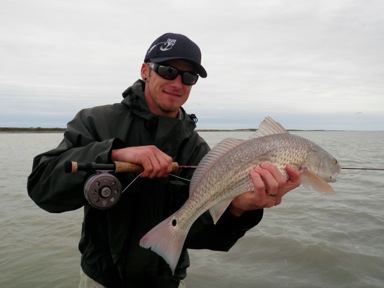
The five day started off nervously as a cold front ushered the anxious anglers and their flight down to south Texas. They left New Mexico with snow on the ground and arrived in South Texas to a cold wind blowing out of the North. The next day we were scheduled to fish but I had my doubts regarding the possibility that any boats would be leaving the dock the next morning. The first morning of scheduled fishing began as I expected. We enjoyed a great breakfast, then nervously waited around the inn for a break in the weather. Each of the four guide boats left at different intervals; four hopeful guides ready to make the most of whatever we found.

OK, so I was not that hopeful myself. The wind was blowing, the weather unstable, and daylight would soon be gone. Two fine young, tattooed anglers were scheduled to fish with me that fateful day. I could tell that they were anxious and read to get out on the water, come what may. I delayed our departure as long as I could, then pushed off and hoped for a miracle awaiting my discovery. The first three hours of the afternoon were nothing to record in one’s fishing diary. We polled the leeward side of a few shorelines and motored looking for clear water and foolhardy fish that had not yet run for deeper water.

After a kind and insightful telephone call from Capt. Scott Sparrow, my mentor, I fired up the outboard and headed for my favorite west side venue in search of podding redfish under the telltale laughing gull. The day turned on a dime! The day became magical in the span of about twenty minutes. The phrase “feast or famine” comes to mind. We feasted (figuratively, of course) on hungry redfish eager to take the fly and fight hard for the rest of the afternoon. Our fun only came to an end that evening because we ran of sunlight and I had to get us back to the inn in order to enjoy a fine dinner with a group of happy anglers. Mark, owner of Four Star Tattoos, and JP, machinist at Los Alamos National Laboratory, were some of the best anglers I have ever had on my boat.

The rest of the week, as weather patterns stabilized and the redfish moved back onto the flats, everyone had great days on the water. I will look forward to seeing Jarrett and my New Mexico friends down here again as soon as possible.
10/26/09 Capt. Scott here. I will prepare an illustrated report in a few days, once our old clients from New Mexico led by Jarret Sasser of High Desert Anglers have arrived. The fishing has been excellent. The red tide has not come anywhere near where I've been fishing in the last two weeks. I know that it's been in the surf, and that dead fish have come into the bay through the passes, but we haven't seen the first signs of either the red tide itself, or dead fish in the central Lower Laguna.
I have been guiding aboard the Stilt, and will have some photos to share of the Stilt in action. My clients have loved fishing from it. It's the ultimate poling skiff, and I am really grateful to Tim and Leslie Clancey for making the first Stilt available to me.
So I will give you the headlines: Fish are thick in some of the west side lagoons, and podding is increasing. The sand action was excellent earlier this week, when we had full sun. No birding action yet, but it should start following the cold front that blew in today. The water temps have been too warm to support autumn birding, but the temperatures plummeted today, and that should help get the birding started.
9/14/09 Capt. Scott here. Take a look at a recent video that I posted to Youtube. It's available here on our videos page. It gives you some idea of what the fishing is like now that the water has risen, and we are fishing some remote lagoons for the first time in months.

8/29/09 Capt. Scott here. Again, I've let too many great trips go by without bringing you up to date, and now where do I begin? How about some headlines, which may encapsulate the big picture? Here's a couple: "Redfish Parade 'Turns On' Before Tides Rise." Or "The Sand is Where It's At on the Lower Laguna." Or how about, "60 Reds Caught in One Day."

If you cast back to my last report, you will find my clients fishing the same west side venue every day with phenomenal results. I have to admit that I have never fished that action exactly in previous years, but every year brings new surprises, and I have to wonder whether the action has changed, or I simply didn't know about it befpore. I suspect it's more the latter.
The tides remained low in early August, as usual, and they stayed low until after the August 15-16 weekend. It was then that I guided Doug and Steve Gauntt, who fished with me together last year. The fishing was so good last year (Doug averaged 20 reds per day) that I feared they might be disappointed this time. But no, the fishing was every bit as good. The Gauntts began their first of three days fishing the Redfish Parade at daybreak. It was almost calm as we approached my favorite west side lagoon, and at first I headed straight for the area where I'd been fishing for the past two weeks. The last time I'd been there I'd been fishing for fun with my friend Michael Mascha, and we had phenomenal redfish action. Indeed, it was Michael's best day of fly fishing on the LLM since he'd moved down here from LA. Here's a shot of one of the fine reds Michael and I caught that morning.
So, for good reasons, I had high hopes for a another remarkable day in the same locale. But there were no fish there! So instead of kicking a dead horse, I shifted to another venue that's become famous for the Redfish Parade––a phenomenon that you will never forget once you've been lucky enough to experience it. What's the Redfish Parade? For about two hours at daybreak, or until the wind comes up, reds and trout will stream from one area to another on top, with backs and tails exposed. The water's depth is usually well over a foot, so the fish don't have to swim on top, but for some reason they do. Many of my old clients have experienced the Parade during the summer low tides.

I saw the signs of the parade, so I shut down on the edge of the game fish. Within a minute, fish were popping up all around the boat, and they guys were casting to one fish after another. I filmed their activities for about two hours, and will be posting my edited video on Youtube and on the Kingfisher site in a couple of days. I'm not sure exactly how many reds Doug and Steve caught, but it was well over 20. Doug also landed a beautiful 25-inch trout, too. As expected, the fish disappeared as soon as the wind rose, so we relocated to a couple of other westside spots that didn't pan out, and then headed to the sand around 11 am. I thought that the best part of the day was over, but I was wrong! The redfish action on the sand turned on so much that Steve and Doug more than doubled their catch. Reds literally poured onto the sand, and you could see multiple feeding reds downwind, within casting range, almost without a break for four hours. They ended up with 47 reds for the day. On top of that, I fished with them toward the end of the day, and stood on one spot near the boat, and landed 12 more reds! It was an embarrassment of riches.
Doug and Steve caught around 15 reds the next day, and then about 30 reds the third day. Most of the reds were caught on the sand on days two and three. Needless to say, they were pretty happy with the fly fishing, and promised to return again.
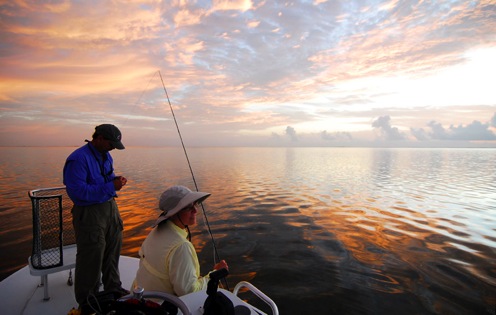
After the Gauntts left, I had the pleasure of guiding Andy Cordova and his wife Romie from New Mexico. It was their first time on the Lower Laguna, so I decided to shift gears and fish the sand at daybreak in hopes that we would find tailing schools. There's nothing more dramatic than to see 50 tails waving at first light. Sure enough, we moved several schools once we made it to the sand, so we shut down and poled away from our noise. Since we didn't see anything immediately, I was getting ready to go elsewhere when, suddenly, 20 tails popped up 50 feet from the boat.


Armed with a Mother's Day Fly, Andy casted into the tails, and only got a nip. Slightly disturbed, the fish moved over and resumed their tailing. Not willing to take chances with the Mother's Day Fly when I knew that the reds would nail a Clouser, I quickly switched Andy's fly. Moments later, he hooked up on this pretty red.
Later, after the sun rose, I took the Cordovas back to the sand, where I waded alongside Romie while Andy stalked fish on his own. The Cordovas caught quite a few fish as the sun rose higher in the sky, and at the end of the day they seemed quite satisfied with their first saltwater fly fishing experience. Later, they wrote to me and confirmed my assessment, by saying, "Thanks again for a great day on the water. Romie and I really enjoyed ourselves. You are now officially our best guide ever." That made me pretty happy!
Then, Rick Hartman and I guided a four-man group from Maryland led by Sherman Baynard, three of whom had fished with us before. The guys fished for five consecutive days, and saw varied action, and several double-digit days for some of them. The highlights of their visit included a 28-inch red and a 26+ inch trout caught by Ed Kilduff, three stellar afternoons on the sand, where they enjoyed nonstop sight casting, and one morning in one of our remote westside venues where reds were feeding on rain minnows in 9-10-inch water. What was unusual about the Baynard group's experience was the remarkable sight casting that we had, almost every day, to podding and tailing trout. Now that's a phenomenon that most people have never seen, but if you know where to go, pods of trout have been showing up on a regular basis. Typically, a pod will have six to 10 small trout, and a couple of 24+ inch fish. You can see the tails from some distance, waving blackly and shimmering like cellophane in the early morning sunlight.

Enough for now! Enjoy the photos, and look for the Redfish Parade video on our Videos page soon.
8/4/09 I had the privilege of guiding John Elphick of Midland and his son Sean, who has just graduated from high school. John gave Sean the fishing trip on the Lower Laguna, and it was his first saltwater fly fishing experience. Quite honestly, when I hear that someone is completely new to the salt, I lower my expectations, and shift into teacher mode. But Sean surprised me with his excellent cast, great vision, and overall feel for the whole experience. While John was more of a novice than his teenage son, I thought about it later, and realized that there are few fathers who willing to give their sons the experience that they want and need, rather than passing down their own preferences and experiences. John was awed rather than overshadowed by Shawn's success, which makes Shawn one fortunate young man.

We headed for the usual westside haunts before sunrise. Since it was Monday, we only saw a couple of boats within a mile of us. My recent experience took us much shallower and farther west than the anglers who were only 200-300 yards away. I was pretty sure that they were catching fish, but I suspected they had no idea of what was happening only a couple hundred yards further west and north of them. When we arrived, I poled west merely on the basis of what we'd experienced over the past two weeks. We couldn't see at fitst what I hoped to find, but I kept going anyway, even though it was getting shallower and harder to pole the boat. On the way there, Sean casted from the front of the Curlew, and caught his first redfish casting to some ambiguous surface breaks. We were off to a great start, but it was still unclear to me if the main action was "on." I poled another 150 yards, and began seeing what I'd hoped to see. Pods of reds were sweeping around in 10-inch, grass-filled water outside the "mullet stream." We eased beyond the mullet into the area where the reds were milling around, pausing to tail and blow up on shrimp and crabs. Sean and I got out of the boat onto the worst wading bottom that I've experienced this year. I keep hoping the reds will move, but they seem to like areas that are beyond the range of most boats and most wading anglers.

With every step, our good fortune became clearer and clearer to us. Before long, we were surrounded by sweeping pods of redfish that seemed to know exactly where we were. Eventually, I realized that we had to stop pushing them away from us, and give them a chance to forget the subtle signs of our encroachment. Sure enough, the pods began to move almost imperceptibly in our direction once we stood our ground, and within a few minutes, Sean was looking at several incoming opportunities. He missed the first several shots, as the fish turned almost psychically within inches of his farthest cast. But by taming his impatience, and waiting for the fish to get closer, he finally put the Kingfisher spoon in front of a 26 1/2 inch redfish The moment he hooked up, about 50 reds that were invisible to us exploded and headed for the boat, where John waited. He got up on the front of the Curlew and tried to get a double hookup, but the school of reds picked up on the elevated angler just before he could reach them.

While John and I tested the bottom for a possible wade, Sean hooked up again, this time on a 27 1/2 inch red. Again the water exploded all around the fighting fish: An invisible school made their presence known to us. The sun was barely up, and he'd already landed three very fine reds--his first three redfish on a fly rod!
The wind came up, and the redfish stopped showing above the surface. Groups of them would pass us like shadows on their way to slightly deeper water, and before long it was clear to us that the action was over. So we celebrated a fine start to the day, and then headed elsewhere to give the sun a bit more time to climb into the cloudless sky. I had my sights set on the south sand, as I hoped to catch the waxing moon's incoming tide. After fishing fruitlessly at another westside venue, I pulled the plug on the westside, and headed east, knowing that regardless of what we found, we'd be there the rest of the day. The rising wind, and the high temperatures would soon render the west side in hospitable to fish and fisherman alike.
We hit it

Sean landed three more reds on the sand, and a couple of ladyfish. Meanwhile, I waded with John, who really got into the action, even though it ended up being more of a practice session for him. He was one happy father though, and that's what the day was about. That night, I invited John and Sean over to the house. Kathy was up at school, and I was alone with the dogs. John and I sat and sipped beer while Sean caught one fish after another on a tiny Clouser--a dozen trout and two snook before we wrapped it up and turned out the lights. I think I'll see them again.
7/23/09 Capt. Scott here. I have guided for the last five days in a row, and frankly this cup of coffee and this rocking chair are pretty precious to me right now. I had the pleasure of guiding Doug and Connie Gauntt for two days, and then another old client––Sam Fason for three days. We had great fly fishing, even though the afternoon wind was fierce––up to 30 mph. But they caught lots of fish––up to 20 reds per day–––on the west side and the sand, as well. I will tell the story a bit later today, after sipping a couple of more cups of coffee, catching up on emails, and uploading my photos.
Well now it's five days later, and I have guided four more days! It's about time I brought you up to date with some of the best July fishing for reds and big trout that we've ever seen. Don't forget to view my latest video of my fishing with Connie and Doug Gauntt, posted on our videos page, and also on YouTube. This report is not complete at this point, and more text and photos are forthcoming.

To summarize, it's been sunny, terribly dry, and windier than your average July. As usual for this time of year, we have started well before daybreak on the west side. The reds have been so thick on some mornings that all we have had to do is to get out of the boat and stand in one area waiting for pods to approach. Meanwhile, redfish schools have moved around, blowing up and creating quite a show. I enjoyed this action with four separate regular clients in the last few days: Connie and Doug Gauntt from Ft. Worth, Sam Fason from Austin, Jim Posgate from Kerrville and his son Keith (who lives in Korea), and Howard Matthews from Ft. Worth.
So what's going on? There seems to be several schools on the west side, holding in the troughs that are about 12 inches deep. If there's enough water, they break up into pods and head further west into critically low, grass filled water, making their movements quite evident, even in strong winds. So instead of starting off in 12 inches of water (which is as deep as the water gets this time of year in the areas where I always fish), I have headed directly for the 8-inch water, where my Curlew can float, but cannot be poled because of mats of dead grass. It's a commitment, and it's a high-risk situation, because not only is the bottom soft, but the boat is litera
We have been using Mother's Day Flies, and Kingfisher Spoons. Some of my clients have tried VIPs, but the water is so shallow and the fish so wary (and large, as a rule) that they have no tolerance whatsoever for surprises. Indeed, Doug Gauntt--who loves to use VIP poppers as much as I do--spent the first three hours of our first morning on the water last week, blowing up one redfish after another with a black VIP. I held off advising him to switch flies, because Doug is a seasoned saltwater fly fisher, and he doesn't need to be told what to do. But after Connie landed the first red, Doug finally switched to a spoon fly and began hooking up. He ended catching around 10-12 that day, but he would have caught many more if he'd started off using an MDF or a KF Spoon. Indeed, on the next day, he caught closer to 20.

Doug and Connie came during the new moon, and we had some pretty high tides (relative to the seasonal low water) during the morning and midday. We fished productively to pods of tailing and cruising redfish for the first four hours or so, then shifted to the east side sand action around 11-12 each day, as the reds were already pouring onto the sand. On the first day, we stopped just beyond end of the grass in what I refer to as the "yellow" water of the sand. It's not as clear and brilliant as the water farther east. We didn't do too well on that wade, but the reds that we did see were heading east. So I gathered my clients, took a deep breath, and headed into water that was too shallow for the Curlew to get back up on plane. I had found reds in that super-shallow venue over the previous month, and I hoped that they would be feeding and taking refuge from the boat traffic in water that was so clear and shallow that you can spot a redfish 100 yards away.

It was a dream wade, and it lasted the rest of the day. It continued to be "on" for the Gauntt's three days on the water. On the second day, it was so good that Doug caught about 20 reds for the day––a not-unusual result for him, by the way. Connie caught 4-6 reds every day herself, so the Gaunttswent home really happy with their results.
Sam Fason fished three days after the Gauntts left, and the action had dimmed somewhat. Instead of hoards of tailing and crashing redfish, we found groups of reds quietly streaming around on top, and stopping to tail briefly before resuming their circuit. Fishing from the boat at first, we found the

Jim Posgate and his son Keith dropped into my schedule in the middle of a steering failure, but my mechanic Brian Robinson saved the day, literally. I was back on the water after a single cancelled day. I took Jim and Keith to the same area where I'd been starting eac

While Jim and Keith were gainfully engaged with abundant redfish, Randy and his son Truett were fishing for fun with Kenny Smith, one of our associate guides. Truett has become a talented fly fisher, and caught several big fish. The photo of him holding two big reds on the homepage was snapped by one proud father who, it should be mentioned, supplied one of the reds for the photo. Rumor has it that Randy will be fishing Truett in the TIFT this weekend. Given Truett's skills and the Cawlfield's on-the-water savvy, Truett has a great chance of taking the Fly Fishing Division.
Howard Matthews arrived for three days on the water after I spent Sunday with Kathy, who is teaching summer school 52 miles away and spends most of the week in an apartment that we have near campus. Howard had fished with me twice before: The first time was awesome fishing, but the second visit was during the super high tides in the aftermath of Dolly. I was really hoping for good conditions, but on the night before our first morning out, the forecast called for "windy." Now "windy" means something different depending on where you live, but "windy" of the type deserving of mention in south Texas means gusts around 30 mph or more. Otherwise, it's so common it's not worth mentioning. So I grimaced, and hoped that they were wrong.

Even though the forecast turned pretty accurate, Howard made the best of what turned out to a darn good first morning. Howard summed it up in his usual succinct fashion after his first day on the water: "I've never seen so many redfish in one place in my life." After stepping out of the boat at 6:30 am, he stood mostly in one spot, struggling to stay upright on a mucky bottom, and landed six fine reds up to about 27 inches long. The six fish he landed didn't include the fish that swiped at his fly and missed, or didn't see it, or had the fly rudely removed from their mouths before they had a chance to eat it––or any number of other things that redfish do or don't do short of getting hooked. It was a bit chaotic, as you might imagine.
Howard's first morning on the west side was the best morning of three. The second day was lackluster, and the third day improved somewhat, offering a lot of opportunities that, unfortunately, weren't exploited by the anglers. Yes, "anglers," for Howard had asked me to join him; and I summarized our performance as "high on the piss-poor" scale. Still, we had numerous encounters with very big reds, and managed to catch a few trout, including one 26/27-inch beauty. But what was special about the last day was the sand action, which turned on the mid-afternoon. The visibility was less then ideal, because we had thin clouds, and were surrounded by glare-producing white clouds in the distance. It was a wonder that we caught any fish at all. But toward the end, we combined my eyesight with his casting skills and had a real fun time spotting reds that were coming in against the wind, feeding head-down, and appearing almost black in the low-angled sunlight. Howard landed a few in wind that was above 25 mph by then. The bubble lines (lines of foam created by the wind) led us northward on the longest wade I'd had in two weeks, and by the time I turned back to retrieve the boat, I could barely see it. As I turned around, I said, "See you in a few minutes." Howard raised his eyebrows and said, "I think it will take longer than that!" He was right.
It was a great three days. We both worked out butts off in one of the most difficult westside wading venues on the lower Laguna. As we parted, I said that I hoped that we'd find reds somewhere else next time. He laughed and agreed, but said he's had a great time.
7/8/09 Capt. Scott here. I have posted a new video of Jim Posgate and me fly fishing on the sand a couple of weeks ago, when we stumbled onto to a school of reds. Check it out on our videos page.

I have been traveling over the past month, but have spent the last week at home, getting ready to resume guiding on the Lower Laguna this coming week. My brother Chip and I fished last Friday, and Kathy and I took the dogs out on the sand on Sunday. The bay was stunningly beautiful under a cloudless sky on both days, so sight fishing on the sand was spectacular. I love this photo, don't you?
Chip and I began on the west side. The water was very low, so we hoped to get into the "redfish parade," in which re

As we entered the lagoon, pods and schools of reds moved away from us, so we knew that there were plenty of fish. But the fish weren't moving much at first. We casted blindly, and targeted waking fish, but didn't have much luck until we waded into a shallower, grassy area, where the mullet were scarce. There we could see reds and trout cruising on top, approaching from the north. We spread out, and faced the incoming fish. They weren't thick, but the action was steady. Given the thick shoal and turtle grass, it was exceedingly hard to place the fly just right. We'd cast 10 times within a foot of the fish's head, only to have them finally see the fly--and either take it or spook on the 11th cast. I often say that presentation is everything. Indeed, the "sight window" of those streaming reds and trout were only a few inches in diameter.
After catching a few reds and a couple of 20-inch trout that were behaving in the same way, we took advantage of the full sun, and headed to an area where, only two weeks earlier, Rusty Pool and his fellow embryologists hit it big in 10 inches of water. We were all guiding that day. Rick and Roel were guiding the Pool group, and I was guiding Chuck Thomas from Midland and his sons Zack and Charlie from Austin. I had guided the Pool group on the previous two days, so it was one happy family on the sand. We were almost within shouting distance, but the odd thing was that Rick and Roel stumbled into a massive concentration of redfish, while my guys had so-so action only 200 yards away. Rick tried to call me, but he was in a "dead" zone for cell coverage. Fortunately, all of us enjoyed a great day, anyway.
Back to Chip and me. We headed for a super shallow area of the sand, and began spottin retreating wakes as we entered the area, I took a deep breath and shut down, knowing that the Curlew would float, but would not be able to get back up on plane. We piled out and headed north. I waded quickly, knowing that we'd pushed the fish away from us by our noisy arrival. Soon, however, we were on our knees, casting to incoming singles and small groups of reds. Wow, it was tough fishing. It was so shallow and clear that the fish could see us 100 feet away. Still, we crouched low and casted as far as we could. I landed two very fine reds before we decided to head in.

Kathy and I went out with the dogs the next morning, July 4th, around 10:00. We soon left the weekend traffic behind, as we moved into shallower and shallower water. Stopping on the sand after spotting some reds and trout, we waded for about an hour, only landing a single 20-inch trout. So we picked up and headed north toward the Saucer, hoping to find a concentration of gamefish. We shut down again, and got out and waded after letting our dogs romp and cool off. The ladyfish were so thick that we quick casting. Indeed, we had to be careful not to drag our flies; otherwise, a pack of ladyfish would come up behind us and seize the prize. Normally, we enjoy catching ladyfish, but when there are literally hundreds of ladyfish, one begins to long for something else. We managed to spot a few reds feeding upwind, and landed a few before calling it a day.
5/31/09 I just finished three days on the water with my old clients Alex and Richard Thompson, and Richard's son Ryan. This year, the Thompsons brought four friends with them, so I was one of three boats on the water. Before I recount the events of the weekend, let me cast back to when my son Ryan was here. Ryan and I were on the water--either together or on separate boats-- for the better part of 10 days. I was especially happy that he was able to fish with our friends Joe and Debbie MacKay from Austin, who stayed with us two weeks ago.
Ryan and I had fished several days during his Christmas visit, and it was really tough fishing. So we hoped that his spring visit would bring him some success. Sure enough, on his first outing, while fishing with Joe and Debbie, he landed a 28-29" red on the sand. I don't have a photo of that fish, but a couple of days later, Ryan and Rick Hartman and I went fishing together, and I snapped a shot of Ryan with a fine 26" red that he caught on the sand. An hour earlier, we poled an area that was full of big trout, and Rick made an incredible cast to this 28" trout that we photographed and released. It's rare in our experience to have a camera nearby when a big trout is landed and released. However, we expect to have a lot more photos like this in the upcoming months, because the trout population is thriving.
It was a memorable morning for lots of reasons, but Ryan would say that it was especially significant because he caught more fish than I did. I was more proud than he was, if that's possible. I often give thanks that I have two sons who love to fly fish, and who, in time, will become top-notch anglers. I have never had the patience for spectator sports, but as I get older, I wouldn't mind watching them.
The three most recent days on the water were classic late spring-early summer days. My first day with the Thompsons started with a mild cold front dominating the early part of the day. We struggled, trying to find fish in windy, largely cloudy conditions. But then the sun came out. We headed for the sand, and had a surprisingly productive afternoon wading as far east as one can go in a boat. Everyone caught reds, which was pretty darn good given the way the day started.
The next day dawned almost calm, so I headed east to see if we could find schools. Sure enough, there were several schools working in the grass along the edge of the sand. But the tides were still very high from the new moon, so we couldn't effectively stalk the schools, because whenever they settled down, they would stop showing due to the depth (18-20 inches). I poled fruitlessly in the semi-glassy water, hoping that one of the schools would turn in our direction, and announce themselves by tailing. Just as I was getting ready to leave the area, a spin fisher, who was chasing the schools around and casting into the schools before they could flee, moved two schools toward us. We could see the wakes of a herd of fish heading in our direction, so I urged the guys to get out of the boat and spread out. I hoped that at least one of them would be able to cast to the passing schools. It turned out that one of the schools passed just to the side of Richard, who hooked up with one of the lead redfish on a Mother's Day Fly. The biggest fish often lead the schools, so it wasn't surprising that Richard's red was a big one. The red gave him a long, spirited fight, and Richard developed a smile that never completely left his face the rest of the day.
We left the schools and headed west hoping to find tailing reds. Stopping at one my favorite tailing areas, I poled the guys slowly into an expanse of glassy water, and suddenly spotted the first of a plethora of tailing pods of 10-25 fish apiece that we fished productively for about two hours. The fish were smallish, but plentiful, and had trout mixed in with them. Rick Hartman and his clients were nearby, and we all caught lots of fish. After landing several reds and a couple of trout, we headed to the sand where the guys managed to catch a couple of reds that were feeding head-down in the 12-inch clear water. The day could have been over, and everyone would have been happy with the catch, but I suggested we head to a "birding" venue in hopes of finding gulls working over pods of reds. As we entered the area, we could see four large groups of birds, working frenetically over invisible fish. Alex elected to wade toward one of the pods, while I poled Richard and Ryan toward another pod. In a few minutes, Alex and Ryan were both hooked up. For the next hour, we poled and waded and landed several trout, three reds, and two gulls that took the flies in midair. (We released them unharmed.) It was quite a full day as we headed toward Kingfisher at around 6 pm.
The third day was as different as the first two, and just as exciting. We started off fishing west, then far east, only to find very few fish working the shallows. Thinking that the tailing pods that we'd found the day before would eventually return to the area, we headed back west around 10 am and discovered that reds and trout were streaming into the area from the north––the first instance of the Redfish Parade that I've seen this year. Casting from the bow, Ryan put his Clouser in front of an unidentified fish only to have a big trout take his fly and jump out of the water! Minutes later, he landed a beautiful, 24-inch trout. Alex managed to catch a 25-inch red a while later, but the wind began to shift to the southeast, and the fish seemed to disappear. A light went on in my head, and I thought, "The sand is going to turn on!" The wind had been out of the north and east for several days, and at the first instance of a southeast wind, the reds will often pour onto the sand. We headed east and turned north onto a "bejeweled" expanse of crystal clear water. After a couple of miles of empty water, we suddenly came upon several reds. We stopped and began wading, and the redfish began pouring onto the sand. The reds were as plentiful as I've ever seen them (except for when they are schooling.) For about two hours, all four of us (they asked me to fish with them) had almost constant opportunities. At first the fish seemed terribly touchy, and would blow up and flee after inspecting an otherwise inpeccable presentation. But Ryan, in particular, found his groove. He may have had the right fly, too, but he landed several before the action ended. At one point he said, "I don't know where to cast!" I felt the same way, because there was almost always more than one red approaching. Everyone was casting constantly! It was wild! I think we caught 13 reds there, and that was the tip of the iceberg of fish that presented themselves to us. As Alex said, "I'm kind of glad they were so tough, because it really made it challenging!"
For the third year in a row, the Thompsons have enjoyed some of the finest fly fishing the Lower Laguna has to offer. Of course, there are many reasons they have done so well, including good weather. Buy I don't know three guys who have a better attitude about angling. They enjoy every aspect of the Lower Laguna, from bird to cloud, to fish, and they never complain about tough days or finicky fish. The Thompsons' successes support the idea that there is, indeed, a relationship between appreciating the hand you're dealt and playing it well.
(Archived fishing reports going back to 6/25/01 available here.)


